Tsamaiso: Maitseboa a $100 mo Khibidung
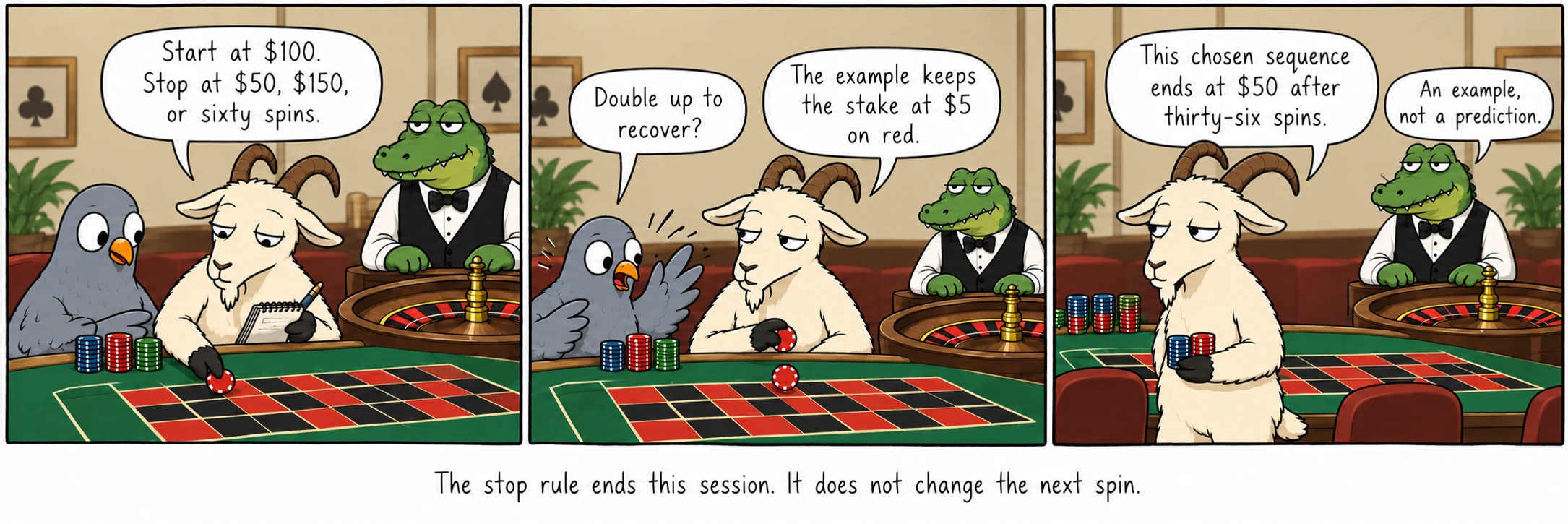
A $100 starting balance, $5 on red and two stop limits. Follow a constructed sequence that reaches the loss limit on spin 36.

Maitseboa a a etsisitsweng mo tafoleng e e phelang: go fitlha go ditikologo di le 60 tsa $5 mo khibidung go tswa mo tekanyetsong ya $100, ka moedi wa tatlhegelo wa $50 le moedi wa poelo wa $50. Moedi wa tatlhegelo o a feditse kwa tikologong ya 36. Motshamekelo o bontsha gore pharologano e lebega jang ka nako ya mmatota le gore goreng molao wa go emisa e le one fela tshwetso e e neng e le botlhokwa.
Leano
Use a standard single-zeroleotwanaLefelaPhaposi e le nngwe e tala e go seng bete ya tekatekano, ya dozen kgotsa ya kholomo e e e khupetsang; motswedi wa molemo wa khasino. Gape: lefela le le lengwe, 0.Bala yotlhe → wheel. Start with $100, stake $5 on redbeteKhibiduBete ya tekatekano mo dipalong di le 18 tse dikhibidu. Sefora: rouge.Bala yotlhe →, and stop at a $50 or $150 balance, or after sixty spins, whichever comes first. These are illustrative settings, not a claim that $100 or $5 is suitable for every player. At exactly sixty fixed-stake spins, expected lossdipaloTatlhegelo e e lebeletswengBoleng jo bo lebeletsweng bo atisiwa ka madi otlhe a a beilweng; madi a palogare a a latlhegang mo motshamekelong kgotsa mo lobakeng.Bala yotlhe → would be $300/37, about $8.11. A rule that can stop earlier has a different expected number of spins.
Ditikologo 1–20
The first twenty chosen results are R B B R R 0 B R R B R B B B R R B R B R. Ten reds, nine blacksbeteNtshoBete ya tekatekano mo dipalong di le 18 tse dintsho. Sefora: noir.Bala yotlhe → and one zero leave the balance at $100. Zero at spin 6 is neither early nor late in a predictive sense: each spin has the same 1/37 chance of zero.
Ditikologo 21–36
The next sixteen results are B B B B B R B B R B B R B B B B. Three reds and thirteen blacks lose $50. The balance first reaches the $50 stop-lossleanoMoedi wa tatlhegeloSelekanyo sa tatlhegelo se se tlhomilweng pele se lo fetsang motshamekelo fa lo se fitlhelela.Bala yotlhe → at spin 36. We stop there. This worked example does not claim that a live table takes a particular amount of time to deal those spins.

Ditikologo 37–60, re seyo
The ledger totals $180 wagered and −$50 net, leaving $50 from a $100 starting balance. At each spin, the expected loss under these standard single-zero rules is the stake divided by 37. Because later bets or stopping can depend on earlier results, expected session loss depends on expected total turnovermadiPalogotlhe ya dibeteMadi otlhe a a beilweng mo motshamekelong kgotsa mo lobakeng, go balwa le diphenyo tse di beelwang gape. Gape: handle, action.Bala yotlhe →. A single worked sequence does not establish the average session result.
Se se diragetseng
The realized loss is $50. It is not a fixed admission price plus a separately charged luck fee. At each placed $5 bet, the expected loss was $5/37; the actual result could be +$5 or −$5. Stopping can reduce expected turnover. It does not make any future red more or less likely.
Dipotso
Ditšhipi di le masome a mabedi mo seatleng go na le di le lesome. Maitseboa a a nnela; ditshenyegelo mo tikologong nngwe le nngwe di fokotsega ka halofo.
On a French even-money betbeteBete ya tekatekanoKhibidu/ntsho, e e sa lekalekaneng/e e lekalekanang, kwa godimo/kwa tlase. Dipalo di le 18, e duela 1:1.Bala yotlhe →, zero loses half the stake. For exactly sixty $5 bets, expected loss is $300/74, about $4.05. With stop rules, the changed payoutsmadiTueloSe bete e e fentseng e se busang, se se bolelwang jaaka “X go 1” mo godimo ga peeletso e e busediwang.Bala yotlhe → can also change when you stop.
About 0.7975% for a particular sixteen-spin block on a fair single-zero wheel. It is not the probabilitydipaloKgonagaloTshono ya maduo, go tswa go 0 go ya go 1 kgotsa 0% go ya go 100%. Palo e le nngwe: 1/37 = 2.70%.Bala yotlhe → of seeing such a block somewhere during an entire evening.
Metlae ya go iketla
Peeletso le ditikologo di beile tlhwatlhwa. Leotwana le beile maikutlo.
Metswedi
- Ethier, S. N. The Doctrine of Chances: Probabilistic Aspects of Gambling.