Hisitori ya Dithulaganyo tsa Roulette
Makgolo a mabedi a dingwaga a batho ba kwala melao ya go fetola peeletso ya bone.
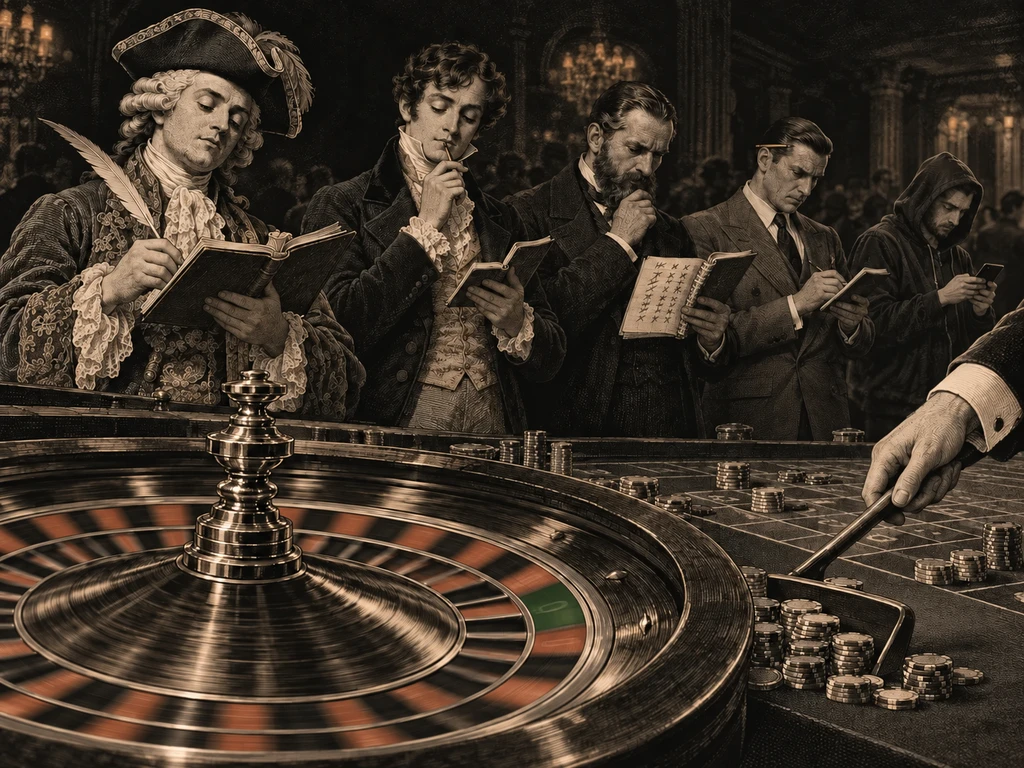
Martingale ke ya lekgolo la bo18 la dingwaga; D’Alembert e bidiwa ka moitseanape wa dipalo yo o neng a sa e rate; Labouchère ke tlwaelo ya ga ranapolotiki wa motlha wa Victoria. Ga go epe ya tsone e e neng e dira le ka nako eo.
Martingale
The 1762 Académie française dictionary records martingaleleanoMartingaleKgatelopele e e menaganyang bete morago ga tatlhegelo nngwe le nngwe. Bonang karolo ya Maano go bona se e se dirang le se e sa se direng.Bala yotlhe → as a gambling term for staking what has been lost. Its 1878 edition explicitly describes doubling after a loss and also uses the word more broadly for betting schemes. These entries document usage; they do not identify a single inventor.
Today the familiar doubling progressionleanoKgatelopele ya dibeteMolao ope o o fetolang peeletso go ya ka maduo a a fetileng. Dikgatelopele tse di tsholetsang morago ga ditatlhegelo di bidiwa negative, tse di tsholetsang morago ga diphenyo positive.Bala yotlhe → aims to recover previous losses and gain one starting unitmadiYunitiPeeletso ya motheo e thulaganyo kgotsa motshameki a dirang ka yone. Dikgatelopele di tlhalosiwa ka diyuniti gore di dire kwa tafoleng epe.Bala yotlhe → when a win arrives. A finite bankrollmadiLetlole la go tshamekaMadi otlhe a a beetsweng go tshameka. Tsamaiso ya letlole ke go swetsa gore ke bokae jwa one jo o tla bo beelang kotsi mo beteng nngwe le mo motshamekelong mongwe.Bala yotlhe → or table limittafoleMoedi wa tafoleBete e nnye go gaisa le e kgolo go gaisa e e letleletsweng. E kgolo go gaisa ke yone e e emisang dikgatelopele tsa go menaganya.Bala yotlhe → can stop the sequence first. The Strategy section shows how those limits affect a session.
D’Alembert
The progression bearing d’Alembert’s name raises the stake by one unit after a loss and lowers it after a win. The name alone does not prove who devised or endorsed the betting rule.
Its mathematical issue is straightforward: on independent spinsdipaloDitikologo tse di ikemetsengTikologo nngwe le nngwe e na le dikgonagalo tse di tshwanang go sa kgathalesege hisitori. Motheo wa palo nngwe le nngwe mo saeteng e.Bala yotlhe →, a run of one outcome does not make the opposite outcome due. A famous namesake does not change that assumption or the payoutmadiTueloSe bete e e fentseng e se busang, se se bolelwang jaaka “X go 1” mo godimo ga peeletso e e busediwang.Bala yotlhe →.
Labouchère
The cancellation system uses a list of numbers to determine the next stake. A win removes entries and a loss adds an entry; the Strategy section sets out the rules and examples. Historical stories about its namesake should be distinguished from evidence that the method creates an advantage.
A sequence may clear with a profit, but a losing run can leave a growing list and larger required stakes. How often it clears depends on the starting list, bankroll, limits and stopping rule. There is no universal success percentage.
Lekgolo la bo20 la dingwaga
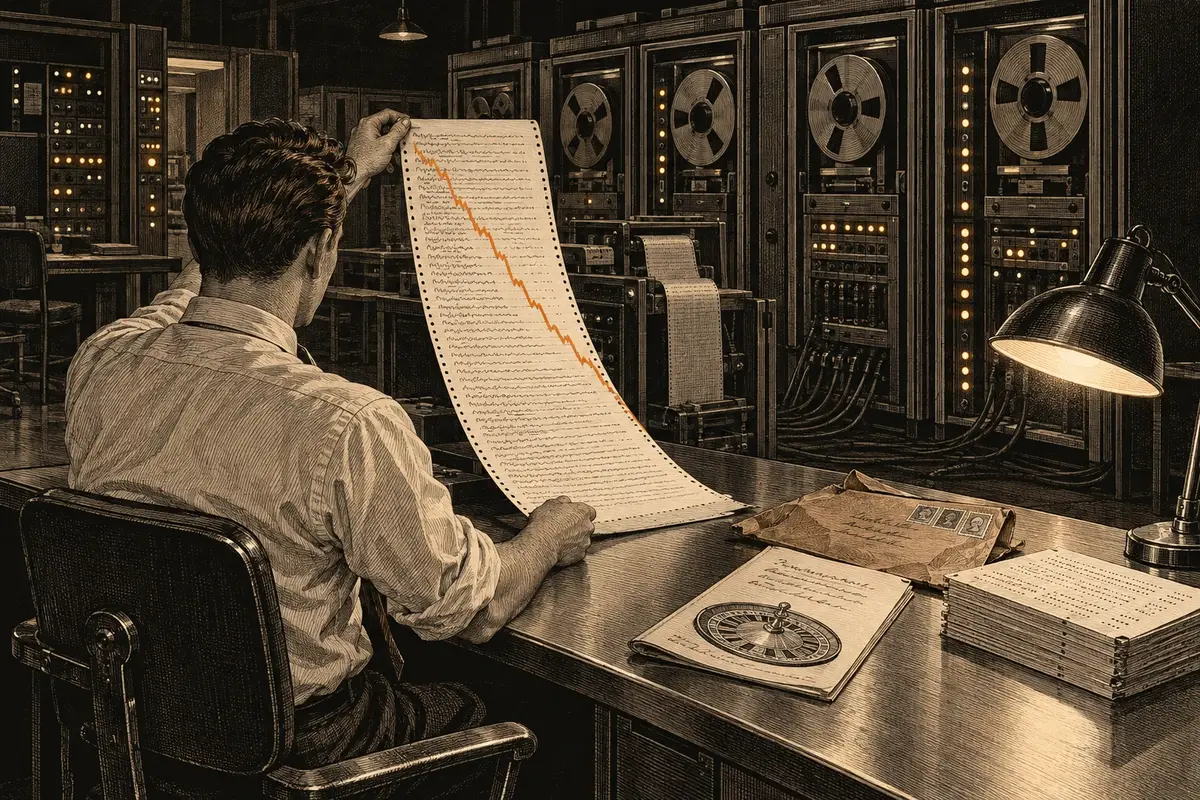
A simulation can show how a specified system behaves under a chosen wheel model. It cannot test every possible rule, and a finite run need not return exactly the theoretical house edgedipaloMolemo wa khasinoKarolo ya peeletso nngwe le nngwe e khasino e e tshotseng ka palogare: 2.70% mo roulette ya Yuropa.Bala yotlhe →.
For independent uniform single-zeroleotwanaLefelaPhaposi e le nngwe e tala e go seng bete ya tekatekano, ya dozen kgotsa ya kholomo e e e khupetsang; motswedi wa molemo wa khasino. Gape: lefela le le lengwe, 0.Bala yotlhe → spins with standard full-loss-on-zero payouts, each unit staked has expected net return −1/37. For a bounded session whose stakes are chosen using information available before each spin, adding the conditional expectations gives expected lossdipaloTatlhegelo e e lebeletswengBoleng jo bo lebeletsweng bo atisiwa ka madi otlhe a a beilweng; madi a palogare a a latlhegang mo motshamekelong kgotsa mo lobakeng.Bala yotlhe → equal to 1/37 of expected turnovermadiPalogotlhe ya dibeteMadi otlhe a a beilweng mo motshamekelong kgotsa mo lobakeng, go balwa le diphenyo tse di beelwang gape. Gape: handle, action.Bala yotlhe →. Stopping or changing stakes can change the distribution of results, but not create positive expectation under those assumptions. Other payouts, such as la partagemolaoLa partageMolao wa Sefora: fa lefela le tswa, halofo ya peeletso ya tekatekano e a busediwa. E fokotsa molemo wa khasino mo dibeteng tseo ka halofo go 1.35%.Bala yotlhe →, need their own calculation.
Tlhamane: Leano la Roulette le le Fenyang ka MetlhaLeano la Roulette la Fibonacci
Ke ka ntlha yang di santse di tshela
A demonstration can end in profit without showing that the method has an edge. Some rules favor frequent small wins at the cost of occasional large losses; others do the reverse. The proportions depend on the exact rules and limits.
When comparing systems, look at all completed sessions, total stakes, losses and stopping conditions. A selected winning example leaves out the information needed to assess the claim.
Dithulaganyo tse di rekisiwang
Systems have also been sold with elaborate names and entry rules. The examples below illustrate the arithmetic of specific rules; they are not evidence of who first invented or marketed them. Waiting for a pattern does not alter the next independent spin’s probabilities.
E e seng thulaganyo
Melao ya go emisa: go tsaya tshwetso pele gore o tla latlhegelwa kgotsa go fenya bokae mme o tsamaye. Gantsi di rekisiwa jaaka karolo ya thulaganyo mme ke tsone fela karolo e e dirang sengwe, ka gonne di fokotsa palogotlhe ya dibete. Ga di na motho yo di bidiwang ka ene, mme seo se a tshwanela.
Dipotso
Martingale, ka lekgolo la dingwaga kgotsa go feta. Go menagana morago ga tatlhegelo ke kakanyo ya ntlha e mongwe le mongwe a nang le yone.
D’Alembert o atametse go gaisa, ka phoso. Pascal, Fermat, Huygens, Bernoulli le Laplace botlhe ba tlhalositse gore ke ka ntlha yang di palelwa.
Ka gonne bontsi jwa metshamekelo bo a fenya, mme bidio ya motshamekelo o o fenyang e tlhwatlhwa tlase go e dira.
Metlae ya go iketla
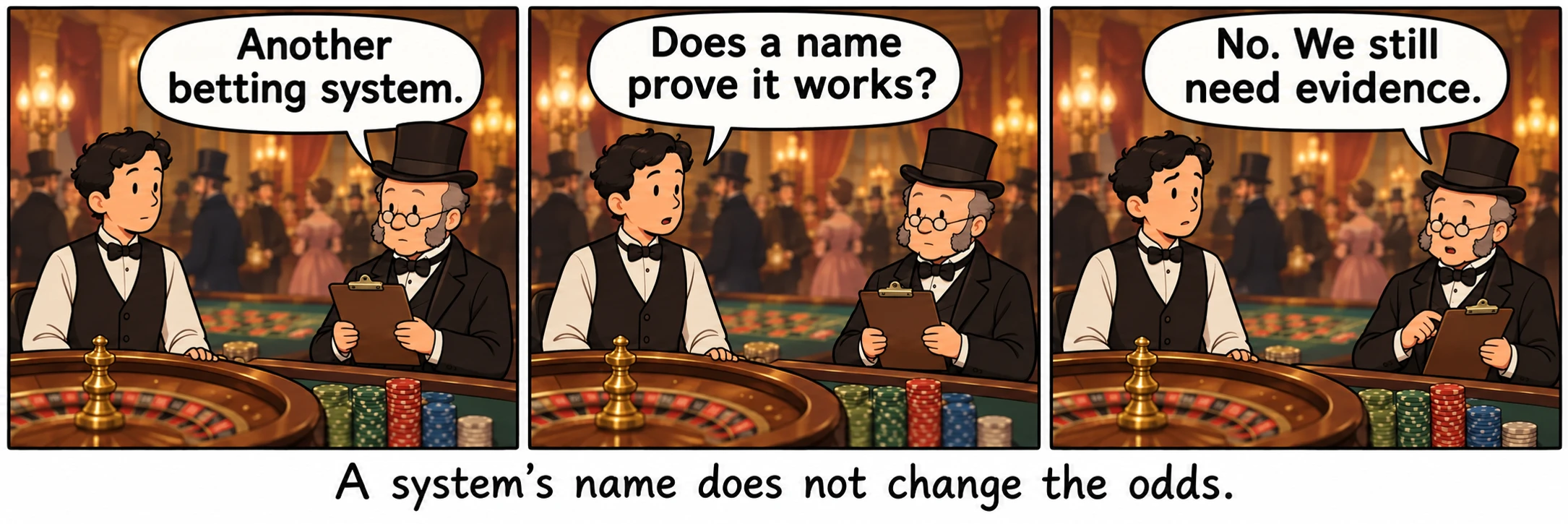
Makgolo a mabedi a dingwaga a maina. Palo e le nngwe.
Metswedi
- Thorp, E. O. “Optimal gambling systems for favorable games.”
- Thorp, E. O. The Mathematics of Gambling.
- Doob, J. L. “Note on probability.”
- Halmos, P. R. “Invariants of certain stochastic transformations: the mathematical theory of gambling systems.”
- d’Alembert, J. “Croix ou pile.”
- Schwartz, D. G. Roll the Bones: The History of Gambling.
- Kavanagh, T. M. Dice, Cards, Wheels: A Different History of French Culture.
- Bollman, M. Mathematics of the Big Four Casino Table Games: Blackjack, Baccarat, Craps, & Roulette.
- Académie française, martingale, 1762
- Académie française, martingale, 1878