Leano la Roulette la Paroli (Martingale e e Boelang Morago)
Leano la roulette la ParolileanoParoliKgatelopele ya positive: menagana morago ga phenyo, simolola sešwa morago ga tatlhegelo kgotsa morago ga diphenyo di le tharo ka go latelana. Gape: Martingale e e boelang morago.Bala yotlhe → le menaganya gabedi morago ga phenyo mme le simolola sešwa morago ga tatlhegelo kgotsa morago ga diphenyo di le tharo ka tatelano.

It does not beat the wheel; it only changes how the losses arrive. A completed uncapped three-win cycle nets either +7 base units or −1. Winnings remain your money when you stake them again; expected loss depends on total turnover.
Tsamayang mo thulaganyong
Phenyo e tsamaya kgato e le nngwe kwa pele. Tatlhegelo, kgotsa phenyo ya boraro, e boela kwa tshimologong.
Dipeeletso le maduo di mo diyuniting tsa bete ya motheo.
Thulaganyo ya roulette ya Paroli e dira jang?
Bet one unitmadiYunitiPeeletso ya motheo e thulaganyo kgotsa motshameki a dirang ka yone. Dikgatelopele di tlhalosiwa ka diyuniti gore di dire kwa tafoleng epe.Bala yotlhe →. Win, and leave it all on the table: the next bet is two. Win again, and it is four. Win a third time, collect seven units of profit and go back to one. Lose at any point and you go back to one as well. That is the whole system. If the progressionleanoKgatelopele ya dibeteMolao ope o o fetolang peeletso go ya ka maduo a a fetileng. Dikgatelopele tse di tsholetsang morago ga ditatlhegelo di bidiwa negative, tse di tsholetsang morago ga diphenyo positive.Bala yotlhe → runs without clipping, a losing cycle ends one unit below its starting balance. A loss at the four-unit stage still gives back four units from the balance immediately before that spin. Three even-money wins in a row happen with probabilitydipaloKgonagaloTshono ya maduo, go tswa go 0 go ya go 1 kgotsa 0% go ya go 100%. Palo e le nngwe: 1/37 = 2.70%.Bala yotlhe → (18/37)³ = 11.5%, about one cycle in nine.
Motshamekelo o lebega jang?
Completed cycles net −1 unit unless three consecutive wins produce +7. Over exactly 100 spins, an exact finite-state calculation gives about 38.43% net-profit probability and expected result −4.56 base units. This calculation starts at one unit, resets after a loss or three wins, and assumes enough funds with no stake clipping. BankrollmadiLetlole la go tshamekaMadi otlhe a a beetsweng go tshameka. Tsamaiso ya letlole ke go swetsa gore ke bokae jwa one jo o tla bo beelang kotsi mo beteng nngwe le mo motshamekelong mongwe.Bala yotlhe → limits and interrupted cycles change the distribution.
- p10 −$500
- p25 −$500
- magareng −$300
- p75 +$30
- p90 +$320
A thulaganyo ya Paroli e a dira?
It does not create a positive expected return. It changes both the distribution and turnovermadiPalogotlhe ya dibeteMadi otlhe a a beilweng mo motshamekelong kgotsa mo lobakeng, go balwa le diphenyo tse di beelwang gape. Gape: handle, action.Bala yotlhe →, so expected session loss can change. Let p = 18/37. Win 7 with probability p³ = 0.115; lose 1 with probability 1 − p³ = 0.885. Expected result per cycle: 8p³ − 1 = −0.078909 units. Expected units wagered per cycle: 1 + 2p + 4p² = 1 + 0.973 + 0.947 = 2.92. Using unrounded values, −0.078909 / 2.919649 = −1/37. This is the standard single-zeroleotwanaLefelaPhaposi e le nngwe e tala e go seng bete ya tekatekano, ya dozen kgotsa ya kholomo e e e khupetsang; motswedi wa molemo wa khasino. Gape: lefela le le lengwe, 0.Bala yotlhe → expected lossdipaloTatlhegelo e e lebeletswengBoleng jo bo lebeletsweng bo atisiwa ka madi otlhe a a beilweng; madi a palogare a a latlhegang mo motshamekelong kgotsa mo lobakeng.Bala yotlhe → per unit wagered.
The tempting thought is that the pressed chipsmadiTšhipiTšhipi e e emelang madi a a sa fetogeng, e bewa mo thulaganyong ya dibete go dira bete. Gape: check.Bala yotlhe → are the casino’s money, so staking them costs nothing. They are yours from the moment they are paid, and each one put back on the table carries the same 2.70%.
Go ka nna jang fa lo leta diphenyo di le nne ka tatelano?
Consider an explicit four-win model: independent standard single-zero bets on redbeteKhibiduBete ya tekatekano mo dipalong di le 18 tse dikhibidu. Sefora: rouge.Bala yotlhe →, one-unit base, no table limittafoleMoedi wa tafoleBete e nnye go gaisa le e kgolo go gaisa e e letleletsweng. E kgolo go gaisa ke yone e e emisang dikgatelopele tsa go menaganya.Bala yotlhe →, and stopping at the first completed four-win cycle or when the bankroll is exhausted. Four wins turn one unit into 16, a net gain of 15, with probability p = (18/37)⁴ ≈ 5.6012%. Each failed cycle loses one unit. With 15 starting units, the chance of completing a four-win cycle before ruin is 1 − (1 − p)¹⁵ ≈ 57.9%. That is higher than the 48.6% win probability of a single 15-unit red bet, but the rewards differ. Conditional on completing the cycle before ruin, the average net session gain is about 9.1 units after earlier failed cycles. Including failures, expected net result is about −1.07 units, versus −15/37 ≈ −0.41 for the single bet. A greater success probability does not imply a better expected return.
A go botlhokwa gore lo emisa kae?
Fela mo sebopegong. Paroli go fitlha go diphenyo di le pedi (tsaya 3) kgotsa di le nne (tsaya 15) e fetola selekanyo sa go itaya le sekgele, e seng molemo. “Parlay” mo beteng ya straight up (go tlogela phenyo ya 35 go 1 e nne) ke kakanyo e e tshwanang ka p = 1/37 le tuelomadiTueloSe bete e e fentseng e se busang, se se bolelwang jaaka “X go 1” mo godimo ga peeletso e e busediwang.Bala yotlhe → ya 1,295 go 1 mo go itayeng ga gabedi ka tatelano, ke gone ka moo bontsi e leng kgang fela e seng tiragatso.
Ke mang yo o e tlhophang, mme ka goreng?
The rule limits a completed losing cycle to one base unit below its starting balance, provided stakes are not clipped. Repeated failed cycles can still exhaust a bankroll, and a loss after wins gives back accumulated gains. Under the stated fair-wheel model, expected loss is 1/37 of expected turnover; a session need not lose exactly that fraction.
Sekaedi · Paroli
Metshamekelo e le 2,000 ya dibete tsa tekatekano go tswa mo letloleng la $1,000.
Bete ya motheo $10 · moedi wa tafole $500 · ditikologo di le 100 mo motshamekelong
Dipotso
E babalesegile ka kakanyo ya gore ga e kgone go tlhagisa tatlhegelo e le nngwe e e masetlapelo. Ga e tlhwatlhwa e kwa tlase: tatlhegelo e e lebeletsweng mo yunitining nngwe le nngwe e e beilweng e a tshwana.
Ntlha nngwe le nngwe ya go emisa e dira go tshwana mo dipalong. Tharo ke ya tlwaelo ka gonne sekgele (diyuniti di le 7) se utlwala se tshwanelwa ke go letelwa mme selekanyo sa go itaya (11.5%) ga se sa tlhoka tsholofelo.
Metlae ya go iketla
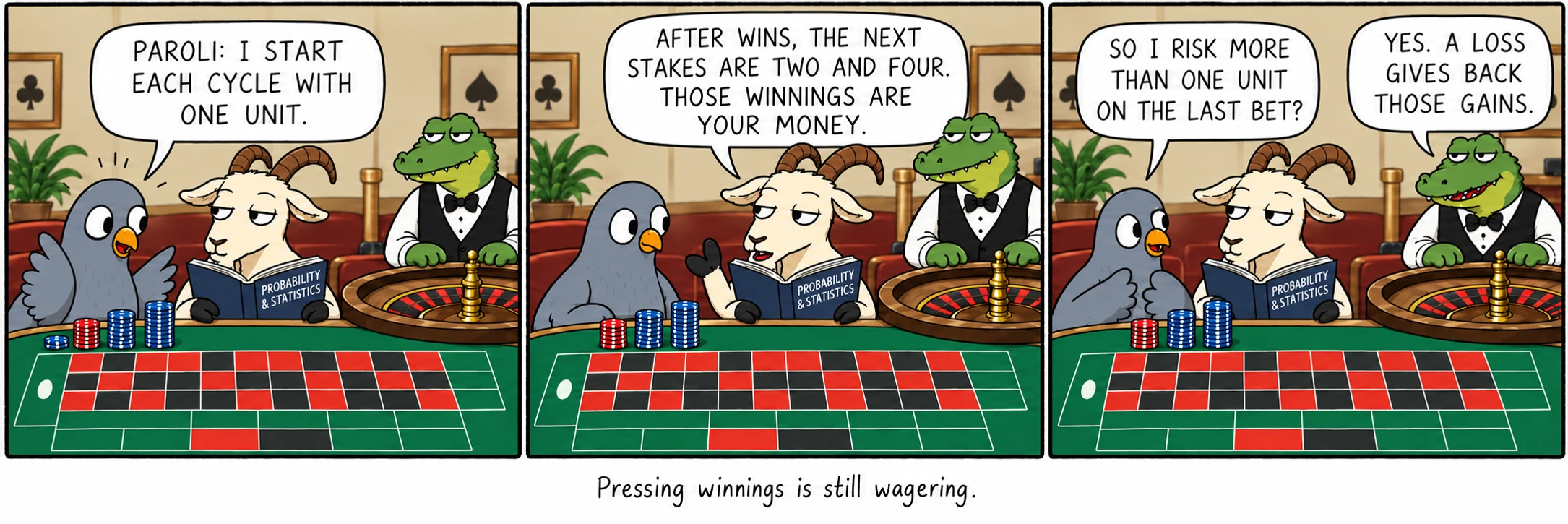
Go oketsa diphenyo le gone ke go bea dibete.
Metswedi
- RouletteDoc. Roulette strategies overview.
- Roulette77. Strategy description and examples.
- Ethier, S. N. The Doctrine of Chances: Probabilistic Aspects of Gambling.
- Epstein, R. A. The Theory of Gambling and Statistical Logic, 2nd ed.
- Taylor, D. G. Games, Gambling, and Probability: An Introduction to Mathematics, 2nd ed.