Pharologano ya Motheo mo Roulette
Pharologano ya motheo ya roulette, modi wa sekwere wa pharologanodipaloPharologanoSelekanyo sa ka fa maduo a anameng ka teng go dikologa boleng jo bo lebeletsweng. E kwa godimo mo straight up, e kwa tlase mo dibeteng tsa tekatekano.Bala yotlhe →, ke sekgala se se tlwaelegileng fa gare ga maduo le se se lebeletsweng.
Per $1 staked, σ is 5.84 for a straight upbeteStraight upPalo e le nngwe, e duela 35:1.Bala yotlhe → and 1.00 for red. For independent spinsdipaloDitikologo tse di ikemetsengTikologo nngwe le nngwe e na le dikgonagalo tse di tshwanang go sa kgathalesege hisitori. Motheo wa palo nngwe le nngwe mo saeteng e.Bala yotlhe → with the same bet and stake, multiply by the stake and the square root of the number of spins.
Molao o o motlhofo
When a normal approximation is suitable, about 68% of results lie within one standard deviationdipaloPharologano ya motheoModi wa sekwere wa pharologano; sekgala sa tlwaelo sa maduo go tswa mo boleng jo bo lebeletsweng.Bala yotlhe → of the mean and 95% within two. These are approximations, not universal rules. For 100 independent $10 bets on redbeteKhibiduBete ya tekatekano mo dipalong di le 18 tse dikhibidu. Sefora: rouge.Bala yotlhe →, the expected result is about −$27 and the standard deviation is $100. The exact binomial probabilities below account for the fact that final results come in $20 steps. An unusual session alone does not establish an advantage.
Gobaneng √N
Expected lossdipaloTatlhegelo e e lebeletswengBoleng jo bo lebeletsweng bo atisiwa ka madi otlhe a a beilweng; madi a palogare a a latlhegang mo motshamekelong kgotsa mo lobakeng.Bala yotlhe → grows in proportion to N; spread grows in proportion to √N. For short sessions, random variation can be large compared with the expected loss. As N grows, expected loss becomes larger relative to that spread. The crossover, where expected loss equals one standard deviation, is at N = (σ/edge)². Using unrounded single-zeroleotwanaLefelaPhaposi e le nngwe e tala e go seng bete ya tekatekano, ya dozen kgotsa ya kholomo e e e khupetsang; motswedi wa molemo wa khasino. Gape: lefela le le lengwe, 0.Bala yotlhe → values gives 1,368 spins for even-money betsbeteBete ya tekatekanoKhibidu/ntsho, e e sa lekalekaneng/e e lekalekanang, kwa godimo/kwa tlase. Dipalo di le 18, e duela 1:1.Bala yotlhe → and 46,656 for straight-up bets. This is a comparison of scales, not a point at which outcomes become certain.
Go e dirisa
To judge whether a session was unusual, compute (result − EV)/σ. A $10 red bettor who finishes 100 spins at +$160 has won 58 spins and lost 42. That result is about (160 + 27)/100 = 1.87 standard deviations above the mean. The exact probabilitydipaloKgonagaloTshono ya maduo, go tswa go 0 go ya go 1 kgotsa 0% go ya go 100%. Palo e le nngwe: 1/37 = 2.70%.Bala yotlhe → of finishing at +$160 or better is about 3.82%. The z-score describes distance from the mean; use the actual outcome distribution to calculate a tail probability.
Phoso ya motheo ya seelo
Dipalo tse di tshwanang di lo bolelela gore go tlhokega ditikologo di le kae go bona molemo mo dintlheng. Phoso ya motheo ya seelo sa diphenyo se se bonweng ke √(p(1 − p)/N). Mo khibidung ka N = 1,000: √(0.4865 × 0.5135 / 1000) ≈ 1.6%. Sekgala fa gare ga tshelete ya tshipi e e siameng le khibidu ke 1.35%, ka jalo morago ga ditikologo di le 1,000 ga lo ise lo kgone go di farologanya ka tshepo. Morago ga di le 10,000 phoso ya motheo ke 0.5% mme lo a kgona. Se ke sone gape se se dirang gore go lemoga leotwana le le sekameng go tlhoke ditikologo di le dintsi jalo.
Tlhagiso ka go kgopama
Straight-up results are far from normally distributed in a short session: most sessions are a steady −$10 per spin with occasional +$350 jumps. The standard deviation remains valid, but the normal 68%/95% rule can be misleading. For even-money bets, the normal approximation becomes more useful as the number of spins grows; an exact binomial calculation avoids approximation error.
Fomula
Dipotso
Ke bosupi jwa gore lo tshamekile metshamekelo e ka nna 40, kgotsa lo ne lo le mo go o le mongwe o o lesego mo go e masome a mane. E dirang gape.
For independent spins with a fixed bet and stake, the standard error of the average is σ/√N. At 10,000 spins it is about 1% of the stake for red, but about 5.84% for a straight-up bet. The spread shrinks with N; the observed average need not move steadily toward its expectation.
Monate wa Dipalo
Ntlha lekang tseno ka bo lona. Tharabololo nngwe le nngwe e phuthilwe; e buleng fa lo ipaakanyeditse.
Mo ditikologong di le 100 tsa leotwana la Yuropa, yunitimadiYunitiPeeletso ya motheo e thulaganyo kgotsa motshameki a dirang ka yone. Dikgatelopele di tlhalosiwa ka diyuniti gore di dire kwa tafoleng epe.Bala yotlhe → e le nngwe mo khibidubeteKhibiduBete ya tekatekano mo dipalong di le 18 tse dikhibidu. Sefora: rouge.Bala yotlhe → e kwa pele ka bonnye diphenyo di le 51, mme yuniti e le nngwe mo beteng ya palo e le nngwebeteStraight upPalo e le nngwe, e duela 35:1.Bala yotlhe → e kwa pele fa palo ya yone e tlhaga bonnye makgetlo a le 3. Dirisang kgolokwane ya tshwaelo go akanyetsa dikgonagalo tsoopedi, morago lo di bapise le dikarabo tse di tlhomameng.
Bontsha tharabololo
Karabo Khibidu: kgolokwane ya tshwaelo e naya 35.6% mme karabo e e tlhomameng ke 35.5%. Bete ya palo e le nngwe: kgolokwane ya tshwaelo e naya 55.0% mme karabo e e tlhomameng ke 50.9%. Tsela e khutshwane e dira mo khibidu mme e fosa mo palong e le nngwe.
Khibidu: diphenyo di na le palogare ya 100 × 18/37 = 48.6, ka phatlalalo ya √(100 × 18/37 × 19/37) = 5.0. Go nna kwa pele go kaya 51 kgotsa go feta; letshwao la bogare, 50.5, le fa godimo ga palogare ka diphatlalalo di le 0.37, mme kgolokwane ya tshwaelo e baya 35.6% fa godimo ga moo. Go kopanya dikgonagalo tse di tlhomameng tsa diphenyo di le 51, 52 … 100 go naya 35.5%.
Bete ya palo e le nngwe: go tlhaga go na le palogare ya 100/37 = 2.70, ka phatlalalo ya √(100 × 1/37 × 36/37) = 1.62. Go tlhaga makgetlo a le mararo kgotsa go feta go kaya fa godimo ga 2.5, diphatlalalo di le 0.12 ka fa tlase ga palogare: 55.0% ka kgolokwane ya tshwaelo. Ka tlhomamo, ke 1 go ntsha dikgonagalo tsa go tlhaga ga 0, 1 le 2, 6.5% + 17.9% + 24.7%, se se tlogelang 50.9%.
Kgolokwane ya tshwaelo e tlhoka maduo a mantsi mo matlhakoreng omabedi a palogare. Khibidu e na le one morago ga ditikologo di le 100; palo e e tlhagang ka fa tlase ga makgetlo a le mararo ka palogare ga e na one. Kgolokwane e bile e naya 8.7% go “go se tlhage gope”, fa kgonagalo ya boammaaruri e le 6.5%. Taylor (2021) o baya binomial le kgolokwane ya tshwaelo fa thoko ga tsone ka tsela e e tshwanang.
Metlae ya go iketla
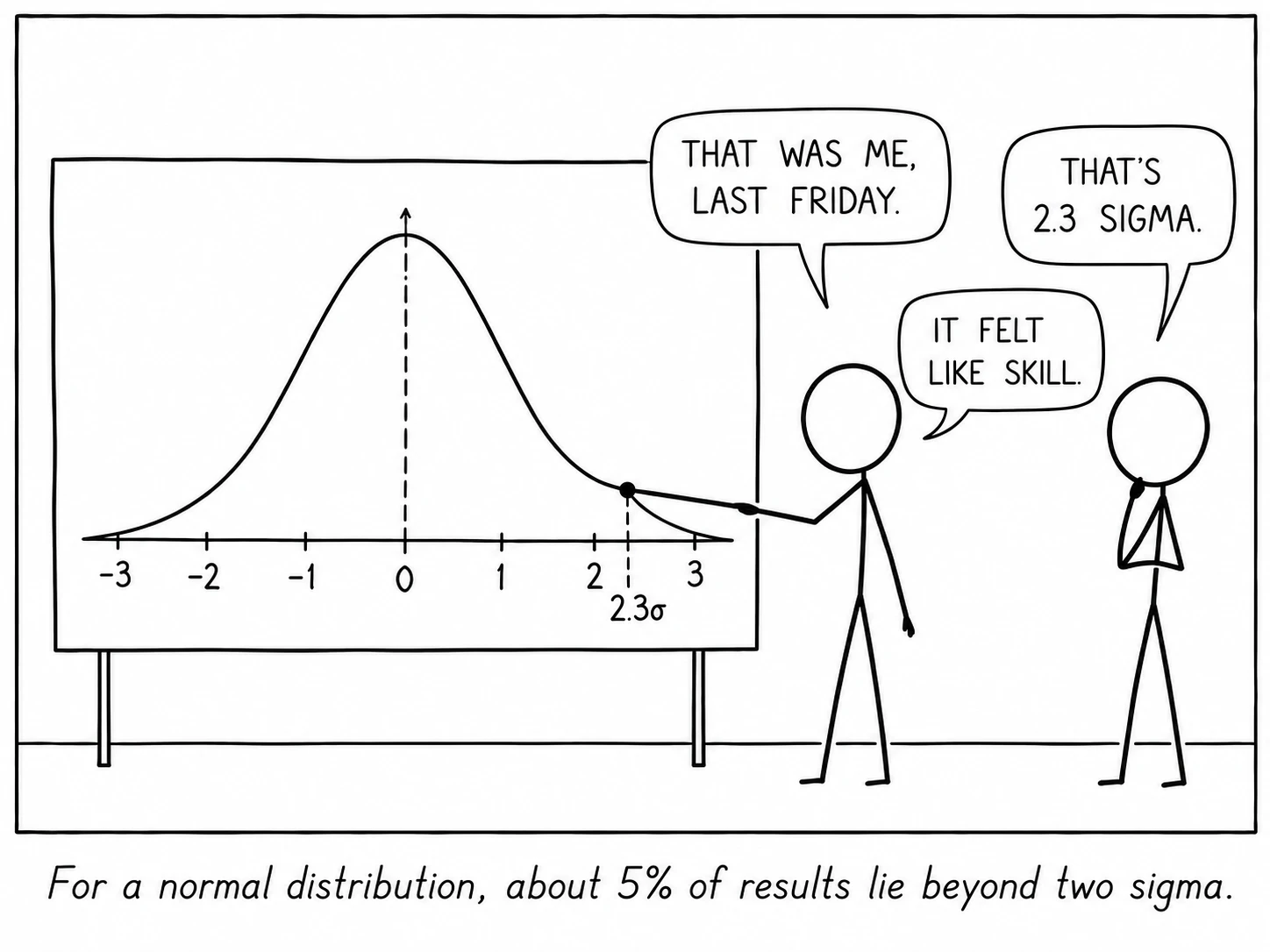
Under a normal approximation, about 5% of results lie more than two standard deviations from the mean.
Metswedi
- Feller, W. An Introduction to Probability Theory and Its Applications, Vol. 1.
- Ethier, S. N. The Doctrine of Chances: Probabilistic Aspects of Gambling.
- Taylor, D. G. Games, Gambling, and Probability: An Introduction to Mathematics, 2nd ed.