Tlhamane: Leano la Roulette le le Fenyang ka Metlha
“Ke na le thulaganyo e e fenyang 80% ya nako.” Gongwe lo na le yone. E santse e latlhegelwa ke madi.
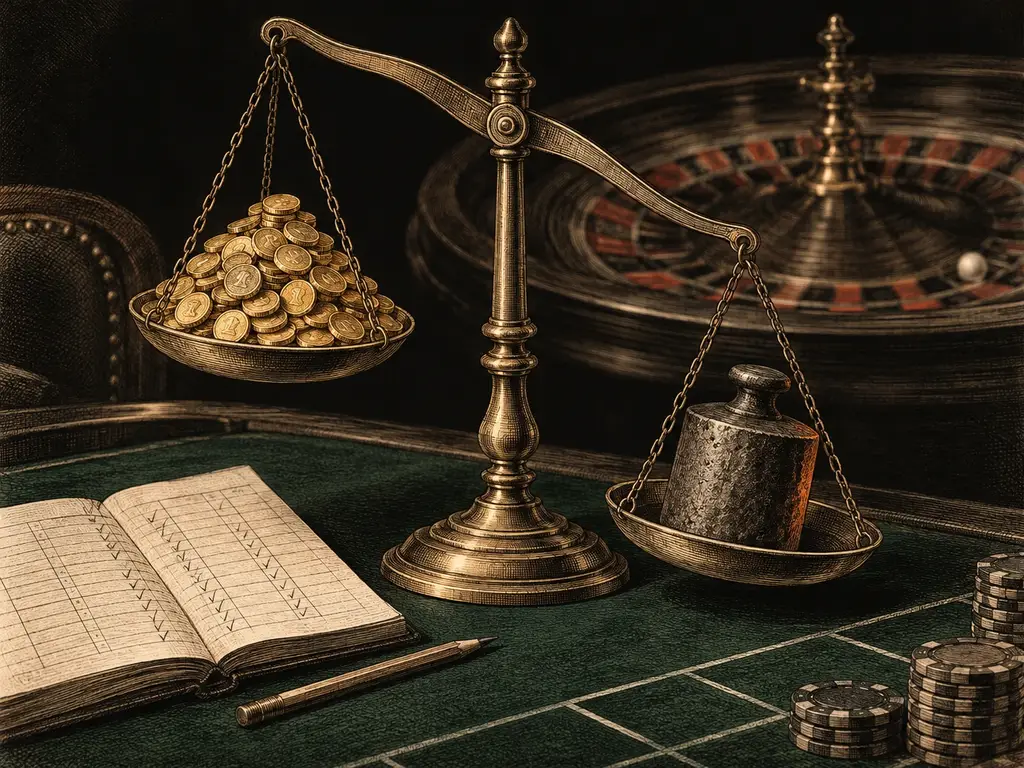
Thulaganyo e ka dira gore metshamekelo e e fenyang e tlwaelege. Ga e kgone go dira gore boleng jo bo lebeletsweng bo nne kwa godimo ga lefela, ka gonne bete nngwe le nngwe e e e bayang ke −1/37 ya peeletso ya yone mme maboleng a a lebeletsweng a a kopana. Dithulaganyo tse di fenyang gantsi go gaisa di latlhegelwa thata go gaisa fa di latlhegelwa.
Se se buiwang
Tumelo: gongwe go na le leano la roulette le le fenyang ka metlha, thulaganyo ya dipeeletso tse di fetogang go ya ka maduo a a fetileng e e fetolang roulette go nna motshameko o o fenyang. Bosupi jo bo neelwang: tatelano ya metshamekelo e e fenyang, bidio ya ka fa o ka fenyang mo roulette ka metlha, bopaki jwa mongwe, tshitswana ya beke ya lesego. Gantsi se se buiwang ke boammaaruri mo go yo o se buang; motho o a se dumela ka gonne se ntse se dira.
Goreng go le phoso, ka mola o le mongwe
For an independent uniform single-zeroleotwanaLefelaPhaposi e le nngwe e tala e go seng bete ya tekatekano, ya dozen kgotsa ya kholomo e e e khupetsang; motswedi wa molemo wa khasino. Gape: lefela le le lengwe, 0.Bala yotlhe → model with standard full-loss-on-zero payoutsmadiTueloSe bete e e fentseng e se busang, se se bolelwang jaaka “X go 1” mo godimo ga peeletso e e busediwang.Bala yotlhe →, each unitmadiYunitiPeeletso ya motheo e thulaganyo kgotsa motshameki a dirang ka yone. Dikgatelopele di tlhalosiwa ka diyuniti gore di dire kwa tafoleng epe.Bala yotlhe → staked has expected net return −1/37. In a bounded session, with bets chosen using information available before each spin, expected lossdipaloTatlhegelo e e lebeletswengBoleng jo bo lebeletsweng bo atisiwa ka madi otlhe a a beilweng; madi a palogare a a latlhegang mo motshamekelong kgotsa mo lobakeng.Bala yotlhe → is 1/37 of expected turnovermadiPalogotlhe ya dibeteMadi otlhe a a beilweng mo motshamekelong kgotsa mo lobakeng, go balwa le diphenyo tse di beelwang gape. Gape: handle, action.Bala yotlhe →.
This statement needs its assumptions. Different payouts require a different edge, and an unbounded theoretical stopping rule cannot be handled by silently ignoring convergence conditions. A finite bankrollmadiLetlole la go tshamekaMadi otlhe a a beetsweng go tshameka. Tsamaiso ya letlole ke go swetsa gore ke bokae jwa one jo o tla bo beelang kotsi mo beteng nngwe le mo motshamekelong mongwe.Bala yotlhe →, table limitstafoleMoedi wa tafoleBete e nnye go gaisa le e kgolo go gaisa e e letleletsweng. E kgolo go gaisa ke yone e e emisang dikgatelopele tsa go menaganya.Bala yotlhe → and a defined stopping rule make a real system concrete enough to evaluate.
Go Atamelana mo Nakong e Telele: Molao wa Dipalo tse Dikgolo mo Roulette
Goreng go lebega go dira
Some progressionsleanoKgatelopele ya dibeteMolao ope o o fetolang peeletso go ya ka maduo a a fetileng. Dikgatelopele tse di tsholetsang morago ga ditatlhegelo di bidiwa negative, tse di tsholetsang morago ga diphenyo positive.Bala yotlhe → produce frequent small wins and occasional larger losses. The exact frequency depends on the bankroll, maximum stake, session length and reset rules. There is no universal 80% MartingaleleanoMartingaleKgatelopele e e menaganyang bete morago ga tatlhegelo nngwe le nngwe. Bonang karolo ya Maano go bona se e se dirang le se e sa se direng.Bala yotlhe → session-win rate.
For an illustrative comparison, suppose a session wins $40 with probabilitydipaloKgonagaloTshono ya maduo, go tswa go 0 go ya go 1 kgotsa 0% go ya go 100%. Palo e le nngwe: 1/37 = 2.70%.Bala yotlhe → 80% and loses $500 with probability 20%. Its expected result is 0.8 × $40 − 0.2 × $500 = −$68. These assumed outcomes are not simulated results for a particular Martingale configuration.
Teko e mongwe le mongwe a ka e dirang
The Strategy Simulator can help explore a specified configuration. Read its bankroll, bet rules, session length and stopping conditions before interpreting the output. A finite simulation can have a positive sample mean even when the theoretical expected return is negative. Repeatability and uncertainty matter; neither one winning session nor a simulation alone proves a universal claim.
Thulaganyo e e sa kgoneng go latlhegelwa
Not placing a wager avoids gambling losses. That is different from finding a betting method with a guaranteed profit. A rule advertised as risk-free may conceal this distinction, an uncovered outcome, a funding requirement or a limit it cannot satisfy.
Dithulaganyo tse di nang le maina, mola o le mongwe nngwe le nngwe
Dithulaganyo tse di rekisiwang ka leina, kgotsa jaaka mokgwa wa go fenya mo roulette, ga di farologane. Nngwe le nngwe ke setlhopha sa dibete, mme bete nngwe le nngwe e duela leotwana 2.70% ya lone. Bollman (2024) o sekaseka di le mmalwa mo leotwaneng la Amerika, kwa nngwe le nngwe e jang 5.26%; fano di mo leotwaneng la Yuropa.
Tlhaloso ya boammaaruri
Stake rules change the distribution of session results and the amount wagered. Under the stated model they do not create an advantage. A progression costs more in expectation than another plan only when it produces more expected turnover at the same house edgedipaloMolemo wa khasinoKarolo ya peeletso nngwe le nngwe e khasino e e tshotseng ka palogare: 2.70% mo roulette ya Yuropa.Bala yotlhe →; larger total stakes should not be assumed without comparing the plans.
Dipotso
Dikgwedi di le thataro tsa metshamekelo ya beke le beke ke metshamekelo e ka nna 25. Martingale e fenya 80% ya yone. Metshamekelo e e latlhegelwang e a tla, mme e megolwane.
No. A stopping rule changes exposure and the distribution of results. It does not create positive expectation under the stated bounded-session model.
It could change the probability model if supported by evidence. That is different from merely changing stakes after independent results.
Monate wa Dipalo
Ntlha lekang tseno ka bo lona. Tharabololo nngwe le nngwe e phuthilwe; e buleng fa lo ipaakanyeditse.
Thulaganyo ya metlae ya ga Mike Caro ya 1997 ya leotwana la Amerika e thibela khibidubeteKhibiduBete ya tekatekano mo dipalong di le 18 tse dikhibidu. Sefora: rouge.Bala yotlhe → le ntshobeteNtshoBete ya tekatekano mo dipalong di le 18 tse dintsho. Sefora: noir.Bala yotlhe →, tse di sa lekalekaneng le tse di lekalekanang, le malefelaleotwanaLefelaPhaposi e le nngwe e tala e go seng bete ya tekatekano, ya dozen kgotsa ya kholomo e e e khupetsang; motswedi wa molemo wa khasino. Gape: lefela le le lengwe, 0.Bala yotlhe →; dipalo tse di khibidu tse di sa lekalekaneng le tse di ntsho tse di lekalekanang; palo 30; le phaposididirisiwaPhaposiNngwe ya diphaposi di le 37 tse di nang le dipalo mo rotor. Gape: slot, cup.Bala yotlhe → nngwe le nngwe mo tatelanong go tswa kwa 11 go dikologa ka tsela ya sesupanako go ya kwa 14. Dirisang melao nngwe ka nngwe. Ke dipalo dife tse di setseng go ka bewa mo go tsone?
Bontsha tharabololo
Karabo None. It places no bets and has no gambling gain or loss; a house-edge percentage is undefined with zero turnovermadiPalogotlhe ya dibeteMadi otlhe a a beilweng mo motshamekelong kgotsa mo lobakeng, go balwa le diphenyo tse di beelwang gape. Gape: handle, action.Bala yotlhe →.
Go thibela khibidu, ntsho, tse di sa lekalekaneng, tse di lekalekanang le malefela go tlogela dipalo tse di le esi le ditlhopha tse dinnye mo go 1 go ya go 36.
Go se nne le tse di khibidu tse di sa lekalekaneng le tse di ntsho tse di lekalekanang go tlogela tse di khibidu tse di lekalekanang (12, 14, 16, 18, 30, 32, 34, 36) le tse di ntsho tse di sa lekalekaneng (11, 13, 15, 17, 29, 31, 33, 35): dipalo di le lesome le borataro. Go thibela 30 go tlogela di le lesome le botlhano.
Mo leotwaneng la Amerika tatelano go tswa kwa 11 ka tsela ya sesupanako go ya kwa 14 e khupetsa diphaposi di le 32 mo go di le 38. Di le thataro tse di kwa ntle ga yone ke 0, 28, 9, 26, 30 le 2. Tsotlhe di le lesome le botlhano tse di setseng di mo teng ga tatelano, ka jalo molao wa bofelo le one o a di tlosa. Thulaganyo e e sa keng e bea ke yone fela e e sa keng e latlhegelwa, se e neng e le ntlha ya ga Caro.
Consider three capped MartingaleleanoMartingaleKgatelopele e e menaganyang bete morago ga tatlhegelo nngwe le nngwe. Bonang karolo ya Maano go bona se e se dirang le se e sa se direng.Bala yotlhe → streams on standard single-zero even-money betsbeteBete ya tekatekanoKhibidu/ntsho, e e sa lekalekaneng/e e lekalekanang, kwa godimo/kwa tlase. Dipalo di le 18, e duela 1:1.Bala yotlhe →. Each uses stakes 1, 2, 4, 8, 16 and 32, then stops after six losses. For one fresh stream with sufficient funds, find its failure probabilitydipaloKgonagaloTshono ya maduo, go tswa go 0 go ya go 1 kgotsa 0% go ya go 100%. Palo e le nngwe: 1/37 = 2.70%.Bala yotlhe →, expected cycle result and expected turnover.
Bontsha tharabololo
Karabo E latlhegelwa ke tsotlhe di le thataro e ka nna gangwe mo dikgatong di le 55, 1.83% ya nako, mme seo se ja diyunitimadiYunitiPeeletso ya motheo e thulaganyo kgotsa motshameki a dirang ka yone. Dikgatelopele di tlhalosiwa ka diyuniti gore di dire kwa tafoleng epe.Bala yotlhe → di le 63. Ka palogare kgato e latlhegelwa ke e ka nna 0.17 diyuniti mo go 6.42 diyuniti tse di beilweng: 2.70%, tlhwatlhwa ya bete nngwe le nngwe mo leotwaneng.
A bet loses with chance 19/37, the zero included. Six in a row: (19/37)⁶ = 0.0183, about 1 in 55, and then the stakes 1 + 2 + 4 + 8 + 16 + 32 = 63 are gone. Otherwise the cycle ends with a win and +1 unit.
Average: 1 × (1 − 0.0183) − 63 × 0.0183 = 1 − 64 × 0.0183 = −0.17 units.
Money staked: the first bet is always placed, the second only after a loss, and so on: 1 + 2 × (19/37) + 4 × (19/37)² + … + 32 × (19/37)⁵ = 6.42 units. And −0.17/6.42 = −2.70%.
For three such cycles, expected turnovers and losses add, even if the streams share spins and are correlated. Under identical cycle rules and sufficient funds, the totals are three times one stream’s expectations. A shared bankrollmadiLetlole la go tshamekaMadi otlhe a a beetsweng go tshameka. Tsamaiso ya letlole ke go swetsa gore ke bokae jwa one jo o tla bo beelang kotsi mo beteng nngwe le mo motshamekelong mongwe.Bala yotlhe → or a shared stop rule can change which bets are actually placed.
Metlae ya go iketla
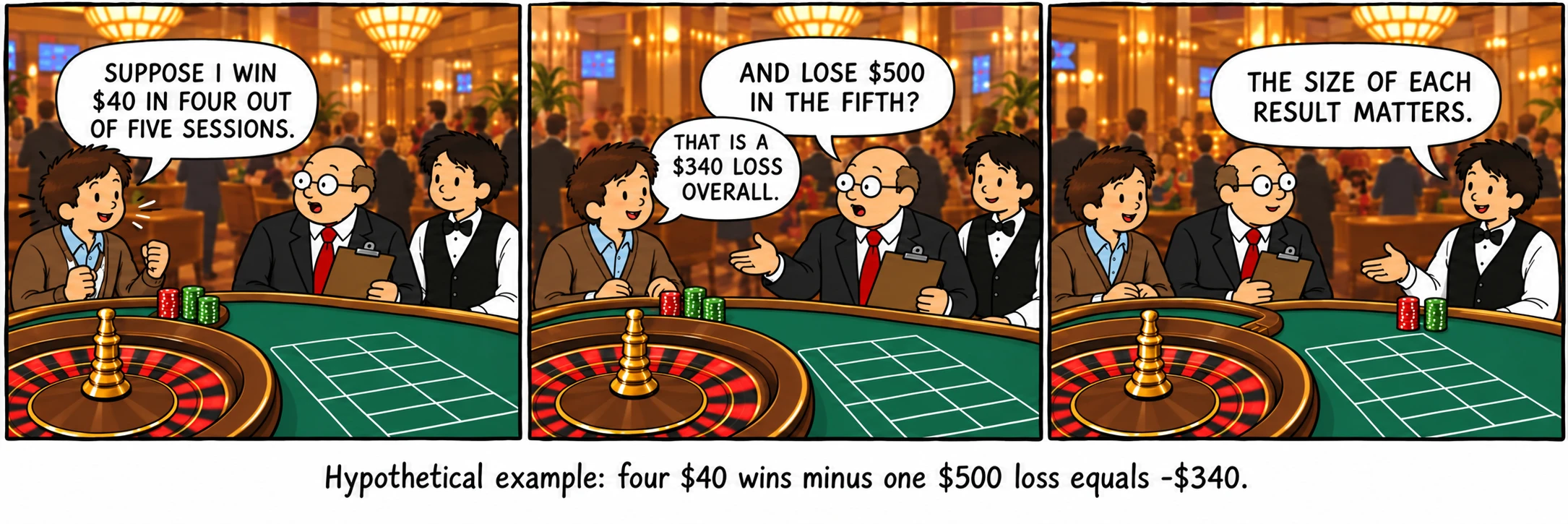
Hypothetical example: four $40 wins minus one $500 loss equals −$340.
Metswedi
- Thorp, E. O. “Optimal gambling systems for favorable games.”
- Thorp, E. O. The Mathematics of Gambling.
- Doob, J. L. “Note on probability.”
- Halmos, P. R. “Invariants of certain stochastic transformations: the mathematical theory of gambling systems.”
- Ethier, S. N. The Doctrine of Chances: Probabilistic Aspects of Gambling.
- Bollman, M. Mathematics of the Big Four Casino Table Games: Blackjack, Baccarat, Craps, & Roulette.
- Bollman, M. Basic Gambling Mathematics: The Numbers Behind the Neon, 2nd ed.